UNIT 2: Ultraviolet-Visible Spectroscopy
|
|
l
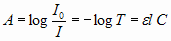
= pathlength (centimeters) C = concentration (molar, M) E = molar absorptivity (M-1 cm-1) |
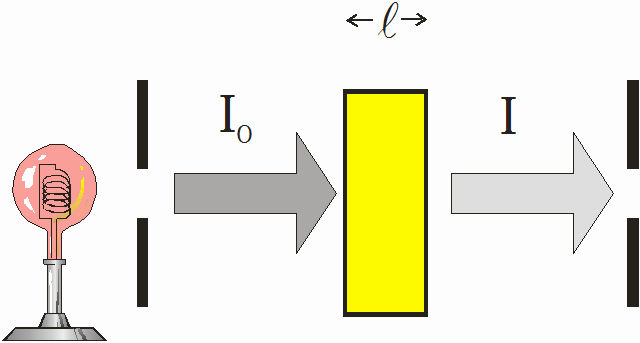
In absorption spectrometry, we measure the intensity of the fraction of light (radiation) of a selected wavelength that passes through a sample. Most light sources produce a whole range of wavelengths. Passing light first through, a filter or special device called a monochromator enables us to select the appropriate wavelength required for the assay.
In practice, two measurements of the intensity of light are made. First, the intensity of light of the selected wavelength (l) reaching the detector when a sample cell (a.k.a cuvette) filled with solvent (blank) is measured (I0). In other words, represents when the concentration of the assayed material is zero. Then the absorption by the sample is recorded (I). Molar absorptivity (which used to be called the extinction coefficient) gives us an indication how good a compound absorbs light at a particular wavelength. It is numerically equal to the absorbance recorded by placing a molar solution in a cell of 1 cm pathlength.
Prelab Question: What are the units of Absorbance and molar absorptivity?
Unit 2: EXPERIMENT 1. Determination of ascorbic acid in Vitamin C tablets.
 |
 Limeys LimeysThe True Story of One Man's War against Ignorance, the Establishment and the Deadly Scurvy David I. Harvie Review by Patricia K. Crimmin 2002 ISBN: 0-7509-2772-0 |
|
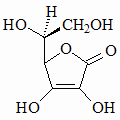
L-Ascorbic acid is an important vitamin. Lack of ascorbic acid in
diet causes scurvy, a disease characterized by weakness, small hemorrhages
throughout the body that cause gums and skin to bleed, and loosening of the
teeth. Scurvy was a serous problem for English sailors in the 1600s and
1700s. James Lind, a British doctor, discovered that sailors would not
develop scurvy if they were given limes and other citrus fruits. Since this
discovery, the Royal Navy made sure that all sailors had lemon juice to
drink when they were at sea for longer than one month.
Many believe that ascorbic acid stimulates immune function and protects people from colds and flu-like symptoms. Vitamin C is a water soluble antioxidant, and plays a vital role in protecting the body. Pollutants such as smog and cigarette smoke contain oxidizing molecules that cause tissue damage. Animals make oxidizing molecules in response to infections. Unfortunately, these molecules while killing infecting organisms and cause tissue damage too. The body requires extra vitamin C when fending infections. Since ascorbic acid is a water-soluble vitamin, risk of getting an over dose is minimal and any unused vitamin C will be excreted. The minimum daily requirement is 30 mg, and the recommended daily allowance is 60-70 mg per person. |
|
Check this site: http://askabiologist.asu.edu/research/scurvy/
Equipment
1) 25 mL volumetric flasks (8)
2) 100 mL volumetric flasks (2)
3) 1 mL, 2 mL, 3 mL, and 4 mL volumetric pipets (one of each)
4) Matching quartz cuvettes (2) (why quartz?)
Reagents
* Reagent grade ascorbic acid (vitamin C)
* Vitamin C tablets
* Absolute ethanol
Procedure
Clean all glassware before starting the experiment.
Prepare a stock solution by weighing accurately about 0.01 g of ascorbic acid, and transfer it into a 100 mL volumetric flask. Dilute with absolute alcohol to the mark. Stopper the flasks, and make sure the solutions are well mixed by turning the flasks upside down.
Pipet 1.0, 2.0, 3.0, 4.0 mL aliquots of ascorbic acid stock solution into four separate 25 mL volumetric flasks (label your flasks, No.1 to 4), and dilute with absolute alcohol to the mark.
Fill two quartz cells (prelab question: why quartz?) with ethanol, set the wavelength range of the spectrometer from 320 to 220 nm, and take a blank spectrum (use the auto-zero procedure)
Obtain absorption spectra from 320 to 220 nm of all four solutions of ascorbic acid according to instrument’s operating procedure.
Weigh accurately a tablet of vitamin C and grind it to fine powder. Weigh about 0.01 g of this power accurately and transfer it into one 100 mL volumetric flask. Dilute with absolute alcohol to the mark.
Pipet 3.0 mL aliquot of this vitamin C solution, transfer it into a 25.00 mL volumetric flask (No.5), and dilute with absolute alcohol to the mark.
Obtain its absorption spectrum from 320 to 220 nm of the solution.
Calculations
Calculate the percentage of vitamin C in a tablet. Calculate the molar absorptivity (E) for ascorbic acid at the wavelength you selected. Discuss what part of the ascorbic acid molecule is accountable for the UV absorption.
Unit 2: EXPERIMENT 2. Quantitative Analysis of Multicomponent Samples
[See G. D. Christian, Analytical Chemistry, sixth edition, Wiley, page 478]
Theory
Quantitative spectrophotometric analysis of multicomponent samples with overlapping spectra can be achieved by chemometric techniques when the identities and the spectra of the components are known. The method is useful for applications where a well-defined process requires quality control monitoring.
For example, the absorbance of a solution, consisting of three components x, y , and z, at the wavelength (i) is the sum of absorbances of all species in the solution.

If the cell pathlength (l) is constant, then for a sample mixture that obeys Beer's law, the absorbance, Ai, at wavelength i is a linear sum:

where aij is the absorbance of pure component j per unit concentration, cj is the molar concentration of j in the mixture, and the sum is taken over all n absorbing components.
For measurements made at various wavelengths the system of simultaneous equations can be expressed in matrix form as:
A = [a] c
where A is a column vector composed from the measured absorbances of the mixture at r different wavelengths, [a] is an r X n matrix whose columns contain the spectra (per unit concentration) of the pure components, and c is column vector whose elements represent the concentrations of the n respective components. The concentration vector can be obtained by the least-squares pseudoinverse matrix computation:
c = [a]+A
Where [a]+ is the pseudoinverse of [a].
By ensuring that the number of wavelengths are greater than the number of components (r > n) the uncertainties in the concentrations can also be determined.
For example, the composition of a mixture containing Co, Ni and Cu can be determined in this way.
Equipment
* 10-mL volumetric pipets (3)
* 25-mL volumetric flasks (3)
* Matching cuvettes (2)
Reagents
* 0.05 M Co(NO3)2 stock solution
* 0.05 M CuSO4 stock solution
* 0.05 M Ni(NO3)2 stock solution
* Unknown mixture of the three components supplied by the laboratory instructor.
Procedure
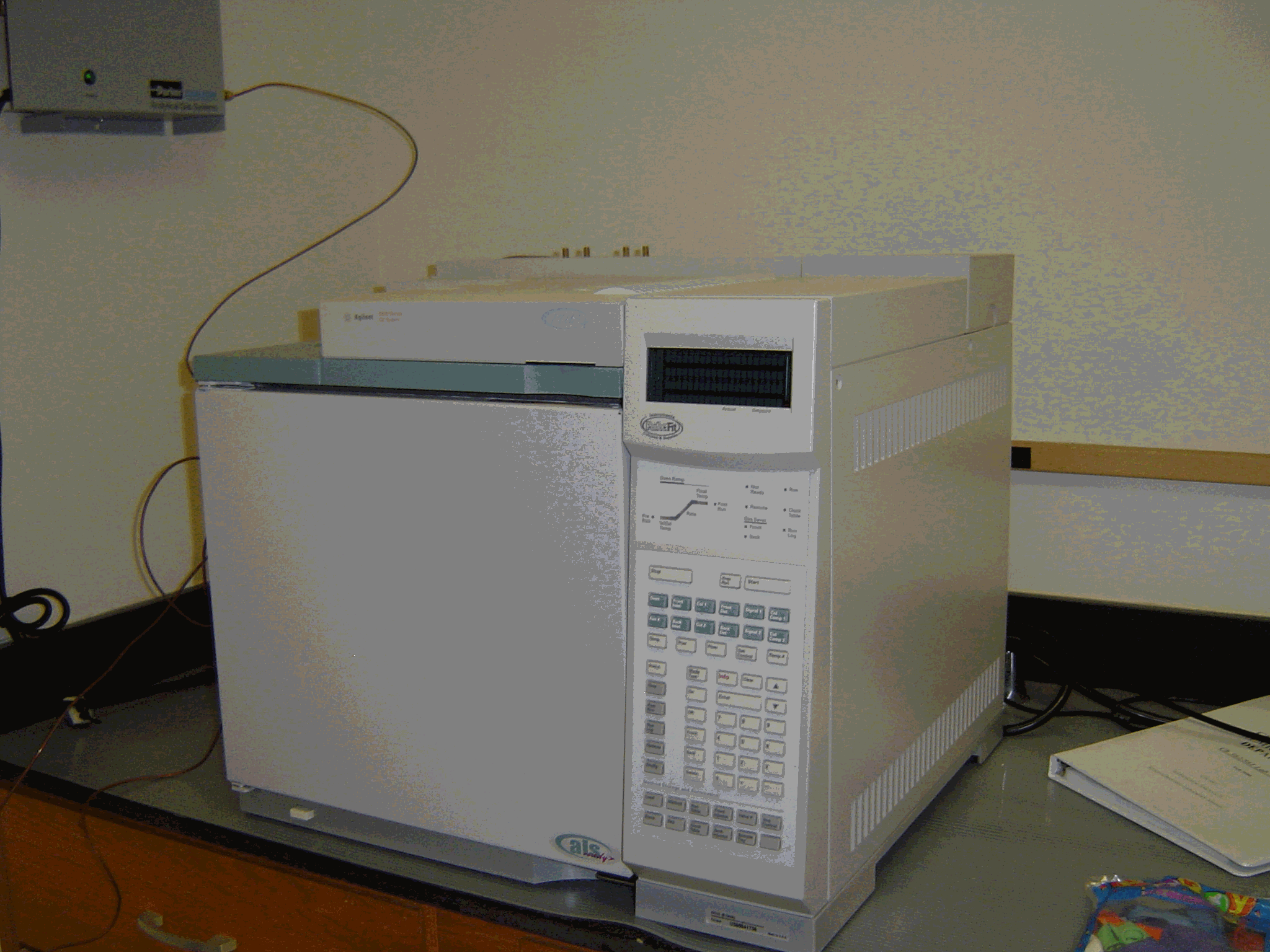
(1) Turn on the U-3000 UV-VIS spectrophotometer according to instrument's operating procedure, and allow it to warm up.
(2) Prepare 0.02 M Cu(II), Co(II), and Ni(II) solutions by diluting the 0.05 M stock solutions with deionized water into three separate 25-mL volumetric flasks. (Caution: DO NOT contaminate the stock solutions, i.e., do not pipet directly from the stock solution bottles. Pour a little more than the required amount to a beaker and pipet the required volume)
(3) Rinse two matching glass cuvettes thoroughly with deionized water (never with cleaning detergents), and fill them with deionized water (avoid air bubbles in the cuvette). Holding the cuvette on the two opaque sides, wipe the two transparent sides to remove moisture, dust, and fingerprints. Insert the cuvettes, containing deionized water, into the REFERENCE and SAMPLE compartment respectively.
(4) Record absorption spectrum of the baseline (from 380 nm to 900 nm) as directed in instrument's operating procedure.
(5) Replace the solution in the SAMPLE compartment with the Cu(II) solution. (Be sure to rinse the cuvette with the Cu(II) solution several times before filling it. Wipe the cuvette, and check for air bubbles.) Record the baseline-corrected-spectrum (from 380 nm to 900 nm) according to instrument's operating procedure.
(6) Repeat steps 3 through 5 for Co(II) and Ni(II) solutions, respectively.
(7) Examine the spectra of Cu(II), Co(II), and Ni(II), and select three wavelengths for analyzing mixtures, and their baselines, of these three components.
(8) Measure accurately the absorbances of the three standard solutions at each of the three selected wavelengths.
(9) Obtain an unknown mixture from the Laboratory Instructor. Record the absorbances of the unknown at the three selected wavelengths.
Calculations
(1) Correct the absorbances of each sample for baseline.
(2) Tabulate your data and results according to data sheet given below.
(3) Use Excel to obtain the concentrations of Cu(II), Co(II), and Ni(II) in the unknown (consult your TA for details of the calculation).
DATA SHEET FOR UV-VIS EXPERIMENT 2 (Unit 2)
NAME:_______________________________PARTNER:________________________
DATE: ________LAB INSTRUCTOR’S SIGNATURE:___________________
Instrument (Model No.): ______________________________________
I. Preparation of Solutions
|
Calibration standards |
||||
| Conc. of Stock Solution (mol/L) |
Volume of Stock Solution (mL) |
Vol after dilution (mL) |
Conc after dilution (mol/L) |
|
| Cu++ | 0.05 | |||
| Co++ | ||||
| Ni++ | ||||
Final volume =________________________________mL
| Wavelength Selected (nm) | |
| Cu++ | |
| Co++ | |
| Ni++ |
II. Spectral Absorbance Data
|
Calibration standards (measured absorbance) |
Unknown Mixture | |||
| Wavelength (nm) |
Cu2+ (abs) |
Co2+ (abs) |
Ni2+ (abs) |
(abs) |
III. Calculations
Calibration Matrix and Mixture Vector
|
Calibration standards (molar absorptivity, [M-1cm-1])1 |
Mixture | |||
| Wavelength (nm) |
Cu2+ (abs/conc) |
Co2+ (abs/conc) |
Ni2+ (abs/conc) |
(abs) |
1
Molar absorptivity is obtained by dividing absorbance by molar concentration, and path length in centimeters.Concentration of Unknowns: (Use Excel; see Appendix)
A set of three simultaneous linear equations must be solved to obtain the concentration of Cu2+, Co2+, and Ni2+ in the unknown mixture. Do not worry if matrix mathematics is unfamiliar to you. However, you must know how Excel can assist you to carry out such complicated math effortlessly. First
Summary of results
|
True Conc. (mol/L) |
Calc. Conc. (mol/L) |
|
|
Cu2+ |
||
|
Co2+ |
||
|
Ni2+ |